

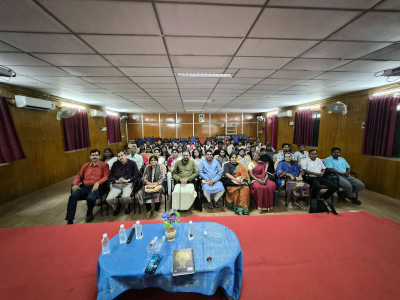
 A conference on “Sri Aurobindo’s Vision of India’s Scientific Heritage and Knowledge Systems: Perspectives on Language, Literature, and Cultural Heritage” was jointly organised by AuroBharati, Sri Aurobindo Society, Puducherry, and Kanchi Mamunivar Government Institute for Postgraduate Studies and Research, Government of Puducherry. The conference brought together scholars, researchers, academics and professionals to deliberate on India’s rich scientific, linguistic, philosophical and cultural traditions and their relevance to contemporary society.
The conference began with a welcome address by Dr. Sashikant Dash, Director, Kanchi Mamunivar Government Institute for Postgraduate Studies and Research (Autonomous), Government of Puducherry. He highlighted Sri Aurobindo’s vision of integral education and emphasised the importance of reconnecting contemporary education with India’s scientific and cultural heritage. He noted that education, in Sri Aurobindo’s vision, should foster the intellectual, physical, emotional, ethical and spiritual dimensions of human development.
Dr. Kishor Kumar Tripathy, Member Secretary, AuroBharati, Sri Aurobindo Society, Puducherry, spoke on Sri Aurobindo’s understanding of India’s ancient knowledge traditions. He explained that Sri Aurobindo regarded ancient India as possessing a highly developed system of knowledge that brought together science, spirituality, philosophy and human development within an integrated vision of life.
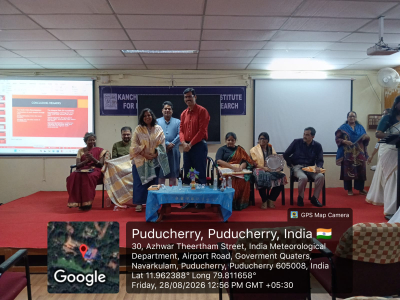 He referred to India’s achievements in areas including mathematics, astronomy, medicine, linguistics, psychology, philosophy and environmental understanding. According to this perspective, ancient knowledge systems were not merely isolated intellectual pursuits but were connected with a deeper spiritual and intuitive understanding of reality.
Dr. Sumit Dey, Regional Director, Indira Gandhi National Centre for the Arts (IGNCA), Puducherry Regional Centre, elaborated on Sri Aurobindo’s vision of Sanskrit and its place in India’s civilisational heritage. He observed that Sanskrit represents a vast reservoir of traditions and intellectual influences that have shaped Indian civilisation over millennia. He highlighted the role of Integral education in preserving and transmitting the profound insights of the Vedas, Upanishads and classical literature, and stressed that the study of Sanskrit can provide insights into the philosophical, scientific, practical and spiritual dimensions of Indian knowledge traditions.
Ms. Alakananda Tripathy, Odisha Finance Services, Finance Department, Government of Odisha, presented her research on “Study of Sanskritization-Prakritization in Classical Odia through Machine Learning.” Her presentation demonstrated how contemporary technological tools can contribute to the study of linguistic evolution and classical languages. She also underlined the continuing relevance of India’s scientific accomplishments and traditional knowledge systems to modern scholarship. In this context, Sri Aurobindo’s vision of an education harmonising scientific inquiry, spiritual wisdom and cultural values was highlighted as an important framework for the integral development of humanity.
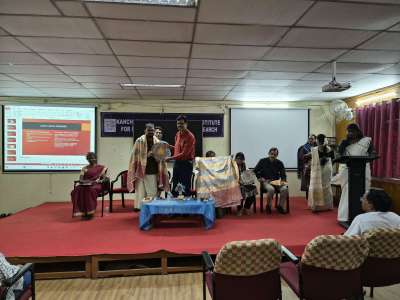 Dr. C. Sairam Sundaram, Training and Placement Officer, Women’s Engineering College, Puducherry, presented a paper titled “Pañcakośa and Sri Aurobindo’s Integral Vision: A Comparative Study of Consciousness and Human Transformation.” The presentation explored the concept of the Pañcakośa and its possible parallels with Sri Aurobindo’s integral understanding of consciousness and human transformation. The discussion also drew attention to the contemporary relevance of Indian knowledge systems in education.
A significant presentation was made by Ms. Veedushi Malik, Architect and Founder, Women Builder Collective, Auroville Bio-region, and Ms. M. Kalaivani, Architect and Founder, Yakshi Studio, Auroville Bio-region, both former students of the Department of History, Postgraduate Diploma in Agamic Studies and Indian Knowledge Systems, Pondicherry University. Their presentation, titled “The Study of the Land Reveals the Study of the Stars: Irumbai Mahakaleshwar Temple—An Exploration of Alignment, Ecology, Cosmology, Ritual, and Sacred Landscape,” examined the relationship between architecture, astronomy, ecology, ritual practices and sacred geography.
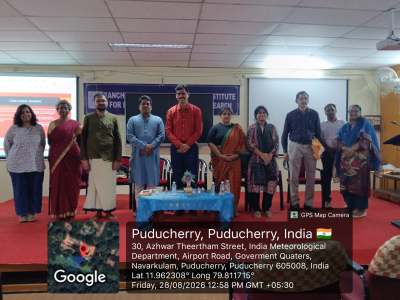
Mrs. Charu Tripathy, Associate Director, AuroBharati, Sri Aurobindo Society, Puducherry, the Convenor of the conference and coordinated the academic programme. Faculty members and students of Kanchi Mamunivar Government Institute for Postgraduate Studies and Research actively participated in the conference and attended the scholarly deliberations.
 The conference provided a multidisciplinary platform for examining the relationship between literature, science, spirituality, architecture, ecology, technology and education. The deliberations underscored the need to study India’s knowledge traditions through contemporary research methodologies while preserving their cultural and intellectual contexts.
With its focus on ancient wisdom and its relevance to sustainable human development, the conference sought to deepen understanding of Sri Aurobindo’s vision of India’s scientific heritage and knowledge systems and to explore how these traditions can contribute to education, research, cultural preservation and the broader development of humanity.